Data Engineering · PDF · 6 pages
Data Cleaning & Preparation Playbook
8 patterns for cleaning dirty, missing and duplicated data across lakehouses and live pipelines.
 Download original guide
Inside the guide
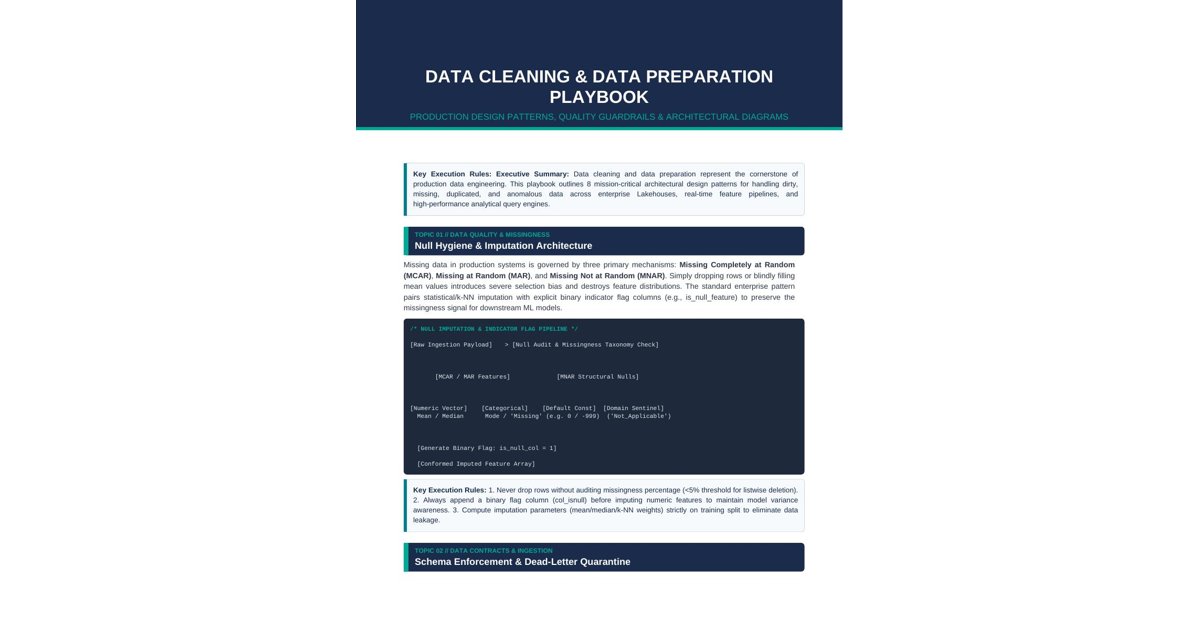
DATA CLEANING & DATA PREPARATION PLAYBOOK PRODUCTION DESIGN PATTERNS, QUALITY GUARDRAILS & ARCHITECTURAL DIAGRAMS
Key Execution Rules: Executive Summary: Data cleaning and data preparation represent the cornerstone of production data engineering. This playbook outlines 8 mission-critical architectural design patterns for handling dirty, missing, duplicated, and anomalous data across enterprise Lakehouses, real-time feature pipelines, and high-performance analytical query engines.
TOPIC 01 // DATA QUALITY & MISSINGNESS Null Hygiene & Imputation Architecture Missing data in production systems is governed by three primary mechanisms: Missing Completely at Random (MCAR), Missing at Random (MAR), and Missing Not at Random (MNAR). Simply dropping rows or blindly filling mean values introduces severe selection bias and destroys feature distributions. The standard enterprise pattern pairs statistical/k-NN imputation with explicit binary indicator flag columns (e.g., is_null_feature) to preserve the missingness signal for downstream ML models.
/* NULL IMPUTATION & INDICATOR FLAG PIPELINE */
[Raw Ingestion Payload] ■■> [Null Audit & Missingness Taxonomy Check] ■ ■■■■■■■■■■■■■■■■■■■■■■■■■■■■■■■■■ ▼ ▼ [MCAR / MAR Features] [MNAR Structural Nulls] ■ ■ ■■■■■■■■■■■■■■■■■■■■■■■ ■■■■■■■■■■■■■■■■■■ ▼ ▼ ▼ ▼ [Numeric Vector] [Categorical] [Default Const] [Domain Sentinel] Mean / Median Mode / 'Missing' (e.g. 0 / -999) ('Not_Applicable') ■ ■ ■ ■ ■■■■■■■■■■■■■■■■■■■■■■■■■■■■■■■■■■■■■■■■■■■■■■■■■■■■■ ▼ [Generate Binary Flag: is_null_col = 1] ▼ [Conformed Imputed Feature Array]
Key Execution Rules: 1. Never drop rows without auditing missingness percentage (<5% threshold for listwise deletion). 2. Always append a binary flag column (col_isnull) before imputing numeric features to maintain model variance awareness. 3. Compute imputation parameters (mean/median/k-NN weights) strictly on training split to eliminate data leakage.
TOPIC 02 // DATA CONTRACTS & INGESTION Schema Enforcement & Dead-Letter Quarantine
DATA CLEANING & PREPARATION PLAYBOOK ENGINEERING REFERENCE GUIDE
Data contracts and declarative schema validation (using frameworks like Pandera, Great Expectations, or Delta Schema Enforcement) prevent corrupted upstream payloads from polluting production tables. Bad records are routed to a Dead-Letter Queue (DLQ) / Quarantine Bucket for asynchronous triage while valid records proceed seamlessly down the pipeline.
/* SCHEMA ENFORCEMENT & DLQ PIPELINE */
[Incoming Raw Event Stream / Batch File] ■ ▼ [Schema Validator & Type Caster] ■■■ Type Check (Int, Float, ISO-Timestamp) ■■■ Null Constraints (NOT NULL checks) ■■■ Value Bounds (Price > 0, Age <= 120) ■ ■■■■■■■■■■■■■■■■■■■ ▼ ▼ [PASS: Valid] [FAIL: Violation] ■ ■ ▼ ▼ [Silver Table] [Dead-Letter Queue (DLQ)] (Clean Parquet) (JSON Payload + Error Reason)
Key Execution Rules: 1. Enforce strict schema validation at the landing layer (Bronze to Silver transition). 2. Store quarantine records in raw original format alongside error metadata (timestamp, failed constraint, raw payload). 3. Trigger alerts if Quarantine DLQ volume exceeds 1% of total batch ingestion.
TOPIC 03 // STATISTICAL CLEANING Outlier Detection & Robust Winsorization Outliers distort statistical aggregations and cause gradient explosion in linear models and neural networks. Depending on distribution symmetry, engineers choose between Z-Score ($|Z| > 3.0$), IQR Bounds ($[Q1 - 1.5 \cdot IQR, Q3 + 1.5 \cdot IQR]$), and multi-dimensional Isolation Forests. Rather than dropping extreme outliers, Winsorization caps values at preset percentile thresholds (1st & 99th percentiles).
Method Applicable Distribution Formula / Logic Recommended Action
Z-Score Method Gaussian / Unimodal |Z| = |(X - µ) / σ| > 3.0 Cap at µ ± 3σ
IQR Bounds Skewed / Non-Parametric Q1 - 1.5*IQR to Q3 + 1.5*IQR Winsorize to 1st/99th Pct
Isolation Forest Multivariate Anomalies Random partitioning depth Flag as Anomaly Row
Confidential - Data Engineering Systems Architecture Page 2
DATA CLEANING & PREPARATION PLAYBOOK ENGINEERING REFERENCE GUIDE
/* STATISTICAL OUTLIER DETECTION & WINSORIZATION */
[Feature Column Vector] ■■> [Distribution Test: Shapiro / D'Agostino] ■ ■■■■■■■■■■■■■■■■■■■■■■■■■■■■■■■■■ ▼ ▼ [Gaussian Distribution] [Skewed Distribution] ■ ■ ▼ ▼ [Z-Score Calculation] [IQR Boundary Check] ■ ■ ■■■■■■■■■■■■■■■■■■■■■■■■■■■■■■■■■ ▼ [Identify Outlier Index] ■ [Apply Winsorization Capping] (Val < P01 -> P01 | Val > P99 -> P99)
Key Execution Rules: 1. Never use Z-score on heavily skewed or multi-modal distributions; default to IQR or Isolation Forests. 2. Prefer Winsorization over deletion to maintain dataset row count and sample alignment. 3. Store raw original values in audit attributes if downstream regulatory compliance requires non-destructive edits.
TOPIC 04 // ENTITY RESOLUTION Probabilistic Record Linkage & Deduplication Duplicate customer or entity records across disparate source systems rarely share exact primary keys. The Fellegi-Sunter Probabilistic Record Linkage framework combines deterministic blocking keys (e.g., Zip Code + Gender) with fuzzy string distance metrics (Jaro-Winkler, Levenshtein Distance) to match entities without $O(N^2)$ exhaustive comparisons.
/* PROBABILISTIC DEDUPLICATION & RECORD LINKAGE */
[Source System A] [Source System B] ■ ■ ■■■■■■■■■■■■■■■■■■■■■■■■■■■■■■■■■■■■■ ▼ [Deterministic Blocking] (Group by ZipCode + BirthYear) ■ ▼ [Candidate Pair Matching] (Calculate Fuzzy String Similarities) ■■■ Jaro-Winkler(Name_A, Name_B) -> 0.92 ■■■ Levenshtein(Address_A, Address_B) -> 0.88 ■ ▼ [Weighted Score Aggregation] ■ ■■■■■■■■■■■■■■■■■■■■■■■■■■■■■■■■■■■■■ ▼ ▼ ▼ [Score >= 0.85] [0.65 <= S < 0.85] [Score < 0.65] ■ ■ ■ ▼ ▼ ▼ [Auto-Merge Match] [Human Review] [Distinct Entity]
Confidential - Data Engineering Systems Architecture Page 3
DATA CLEANING & PREPARATION PLAYBOOK ENGINEERING REFERENCE GUIDE
Key Execution Rules: 1. Always perform blocking to reduce comparison space from quadratic $O(N^2)$ to linear $O(N \cdot B)$. 2. Use Jaro-Winkler for short strings (person names) and Levenshtein / Token Sort Ratio for addresses. 3. Establish a three-tier decision boundary: Auto-Match, Human-in-the-loop Review Queue, and Non-Match.
TOPIC 05 // TEXT CLEANING String Normalisation & Categorical Standardization Unstructured and user-entered text fields harbor typos, irregular casing, white space noise, and non-standard symbols. Text standardization pipelines execute ASCII lowercasing, unicode normalization (NFC/NFKD), regex whitespace stripping, and canonical dictionary mapping before categorical encoding.
Raw Input String Cleaning Step Applied Cleaned Conformed Value
N.Y.C. , USA! Regex strip punctuation & whitespace nyc usa
François-123 Unicode NFKD strip accents & digits francois
+1 (555) 019-2831 E.164 Regex Phone Standardisation +15550192831
2026/10/16 10:21:29 ISO 8601 Timestamp Parsing 2026-10-16T10:21:29Z
/* STRING NORMALISATION & CANONICAL MAPPING */
[Raw Unstructured Text Field] ■ ▼ [Unicode NFKD Normalization] ■■> Strip Diacritics / Accents ■ ▼ [Regex Lowercasing & Punctuation Strip] ■ ▼ [Canonical Synonym Dictionary Map] (e.g. 'NY' -> 'New York') ■ ▼ [Frequency-Based High-Cardinality Grouping] ('Other' Binning) ■ ▼ [Clean Conformed Categorical Feature]
Key Execution Rules: 1. Apply Unicode NFKD normalization to eliminate accents and special symbols safely. 2. Group low-frequency categorical levels (<1% dataset share) into an 'Other' bucket to prevent curse of dimensionality. 3. Use ISO 8601 formats for all datetime strings across analytical data stores.
TOPIC 06 // PIPELINE GUARDRAILS Data Observability & Anomaly Monitoring Data Quality is not a static one-time script; it requires continuous monitoring. Data Observability engines track 5 key pillars: Volume, Freshness, Schema Shift, Null-Rate Drift, and Distribution Anomaly. When anomalies occur, automated circuit breakers halt downstream DAG execution.
Confidential - Data Engineering Systems Architecture Page 4
DATA CLEANING & PREPARATION PLAYBOOK ENGINEERING REFERENCE GUIDE
/* DATA OBSERVABILITY & AUTOMATED CIRCUIT BREAKER */
[Batch / Streaming Pipeline Ingestion] ■ ▼ [Data Observability Telemetry Collector] ■■■ Volume Metrics (Row count vs 7-day moving avg) ■■■ Freshness Metrics (SLA threshold check) ■■■ Null Percentage Drift (Z-score on null rates) ■■■ Distribution Shift (Kolmogorov-Smirnov Test) ■ ■■■■■■■■■■■■■■■■■■■■■ ▼ ▼ [Within Bounds] [Anomaly Detected] ■ ■ ▼ ▼ [Proceed DAG] [TRIP CIRCUIT BREAKER] ■■■ Halt Pipeline Execution ■■■ Trigger Slack / PagerDuty Alert
Key Execution Rules: 1. Set volume alerts on 7-day rolling moving averages with 3-sigma bounds. 2. Implement Kolmogorov-Smirnov (KS) tests on continuous numerical features to catch distribution shift before model scoring. 3. Fail-safe: Always stop pipeline propagation if null percentage spikes by >15% over baseline.
TOPIC 07 // LAKEHOUSE ARCHITECTURE Medallion Cleaning Pipeline (Bronze to Silver) In the Medallion Lakehouse Architecture, the Bronze layer maintains an immutable append-only record of raw data. The Silver layer executes the full data cleaning lifecycle: schema enforcement, type casting, deduplication, referential integrity validation, and business logic normalization.
/* MEDALLION BRONZE-TO-SILVER TRANSFORMATION */
■■■■■■■■■■■■■■■■■■■■■■■■■■■■■■■■■■■■■■■■■■■■■■■■■■■■■■■■■■■■■■■■ ■ BRONZE LAYER (RAW DATA) ■ ■ Immutable append-only landing zone (JSON, CSV, CDC streams)■ ■■■■■■■■■■■■■■■■■■■■■■■■■■■■■■■■■■■■■■■■■■■■■■■■■■■■■■■■■■■■■■■■ ■ ▼ ■■■■■■■■■■■■■■■■■■■■■■■■■■■■■■■■■■■■■■■■■■■■■■■■■■■■■■■■■■■■■■■■ ■ SILVER CLEANING PIPELINE ■ ■ 1. Schema Validation & Strict Type Casting ■ ■ 2. Deduplication via Delta Lake MERGE / Window Functions ■ ■ 3. Null Imputation & Outlier Winsorization ■ ■ 4. Structural Conformity & Foreign Key Validation ■ ■■■■■■■■■■■■■■■■■■■■■■■■■■■■■■■■■■■■■■■■■■■■■■■■■■■■■■■■■■■■■■■■ ■ ▼ ■■■■■■■■■■■■■■■■■■■■■■■■■■■■■■■■■■■■■■■■■■■■■■■■■■■■■■■■■■■■■■■■ ■ SILVER LAYER (CLEAN DATA) ■ ■ Conformed, deduplicated, trusted relational Parquet tables ■ ■■■■■■■■■■■■■■■■■■■■■■■■■■■■■■■■■■■■■■■■■■■■■■■■■■■■■■■■■■■■■■■■
Confidential - Data Engineering Systems Architecture Page 5
DATA CLEANING & PREPARATION PLAYBOOK ENGINEERING REFERENCE GUIDE
Key Execution Rules: 1. Never execute business aggregation or metrics calculations in the Silver layer (reserve for Gold). 2. Ensure Silver transformations are idempotent: re-running a batch must produce the exact same Silver state. 3. Maintain raw source metadata fields (_ingested_at, _source_file) for lineage auditing.
TOPIC 08 // HIGH-PERFORMANCE COMPUTING High-Performance Cleaning: Polars vs Pandas Traditional Pandas relies on single-threaded Python execution and expensive memory copies over NumPy arrays. Polars leverages a Rust multi-threaded query engine, Apache Arrow in-memory columnar layout, and Lazy Evaluation to optimize filter and cleaning queries before execution.
Feature / Dimension Pandas (Eager) Polars (Lazy Engine)
Memory Format Custom NumPy / Python Objects Apache Arrow Columnar Format
Execution Engine Single-threaded Eager Rust Multi-threaded Work-Stealing
Query Optimization None (Executes step-by-step) Predicate & Projection Pushdown
Memory Footprint High (3-5x dataset size copy) Zero-Copy Arrow Slices
/* POLARS LAZY QUERY OPTIMIZATION ENGINE */
[Parquet Storage Files] ■ ▼ [polars.scan_parquet()] <■■ Lazy Frame Plan Construction ■ ▼ [Polars Query Optimizer] ■■■ Predicate Pushdown (Filter at file scan level) ■■■ Projection Pushdown (Read only required columns) ■■■ Expression Folding (Combine string cleaning steps) ■ ▼ [Multi-threaded Rust Execution Engine] (Zero-Copy Arrow Memory) ■ ▼ [Cleaned Polars DataFrame]
Key Execution Rules: 1. Use pl.scan_parquet() lazy evaluation over pl.read_parquet() eager loading for large datasets. 2. Chain cleaning expressions inside a single .with_columns() block to enable Polars parallel execution. 3. Avoid falling back to Python .map_elements() lambdas inside Polars; use native expression syntax.
Confidential - Data Engineering Systems Architecture Page 6